The Things I Never Knew About My Sensitivity – And Why It Matters!
So why was it that throughout my struggles with shyness, anxiety, burnout, constant overwhelm, and addiction, I was kept hidden from the truth of what being sensitive really means?

As I sit here reflecting on what could have been, I feel bemused that for nearly 50 years of my life, I never fully explored one of my core traumas. My sensitivity.
I guess I must have missed it somewhere down the line and repressed it while battling with the constant onslaught of being labelled as either too shy, lazy, avoidant, aggressive, or dismissive. Whereas now I realise that repressing awareness of my sensitivity was simply a protective response to something inside of me that I never fully understood. Until now.
Like many, I was told time and again to ‘stop being so sensitive’, or that I was a ‘sensitive soul’. Statements that felt tarnished with shame by the tone and inflection in their delivery, patronising, somewhat apologetic for my state of being. All of which made me feel small, and amplified my need to hide away from everyone.
Being a model in my teenage years, it was instantly assumed that I must be confident. Even in instances where I summoned the courage to tell people I wasn’t, this was more often than not read as pretence, or an attempt to project some air of humility.
What’s interesting was how my cold, stone look of terror, born from being internally wracked with fear, apparently carried some kind of kudos in the attraction stakes with women, who would often vocalise that I looked ‘mysterious’.
Maybe I should re-adopt this philosophy as a now confident adult male, act as if I’ve just seen a tiger over their shoulder, sweat profusely, behave sketchily as though I’m searching for the nearest exit, and I’d bet any money my dance card would be full for the coming month.
Perhaps reliving the feeling of internally combusting from stress in romantic situations will pay dividends in my love life.
But the truth was, there were far darker thoughts and feelings I was hiding during this time of my life that escaped everyone’s attention.
I hated myself. I hated that I was shy. I hated that I blushed on trains. I hated that I stumbled over my words. I hated that I feared standing up to bullies. I hated being deemed good looking and the attention that came with it. I hated that I couldn’t manage my feelings when my mother was dying of cancer, or convey to her how scared I was that I might lose her. And when she eventually died, amplified by everything else I feared and hated about my life, it was at this point that I found my new best friend in the form of drugs and alcohol.
I had always drunk from an early age, but never as seriously as I did when I was grieving for her. It was as if I had suddenly been given a superpower in liquid form, one that stripped away loving, caring, being sensitive, along with other emotions I couldn’t, or didn’t want to, name.
So, I subconsciously started doing whatever I could to be the opposite of sensitive, and so began the era of insensitivity, ego, and bravado, which my addiction was only too happy to accommodate. My modus operandi became to create as much chaos as possible as a distraction and deflection, a way to blot out any trauma or insecurities I felt. And it worked for a good while, before it came crashing down around me.
So why couldn’t I name with confidence that I was sensitive?
Because like many, I didn’t have the first clue what being sensitive really meant, and when I did attempt to name it, it was often met with judgement or a sense of unease. When we hear the word ‘sensitivity’, many of us recoil, either in shame or discomfort, because over the course of many decades society has found a way to hide the truth of what sensitivity is, what it is designed to do, and why it is one of our greatest survival assets.
Over time, a stigma has been placed around this word, suggesting it is a failing of some kind, a weakness, a vulnerability that serves no purpose, when in fact it is quite the opposite. If you think for a moment that creativity, empathy, passion, strategic ability, or adaptability are weaknesses, then you have not understood sensitivity’s makeup. Because this is where all of these powerful traits stem from.
Sensitivity isn’t a niche trait.We are all sensory beings.
Let me clarify: sensitivity doesn’t just exist in a select few on the higher end of the scale, commonly termed “Highly Sensitive People” or “hyper-empaths.” Contrary to what you may have read online, often written by pop psychologists, sensitivity exists on a far broader scale. It shifts and fluctuates in every one of us, depending on our environment, health, energy levels, and resilience, all of which are interconnected and significantly impact each other.
Elaine Aron’s foundational work on Sensory Processing Sensitivity did acknowledge that sensitivity can vary depending on environmental context and stimuli. However, in later interpretations of her work, particularly through the development of the Highly Sensitive Person framework, sensitivity became framed more as a fixed trait.
But here’s the reality: this latter view doesn’t fully align with the wider body of scientific research we have today. The broader scientific community now understands sensitivity as dynamic, something that shifts and fluctuates.
Theories such as Polyvagal Theory, the Window of Tolerance, Differential Susceptibility, Interoception, Neuroplasticity, and Allostatic Load all point to the same conclusion: sensitivity is fluid, shaped by a complex interplay of biologically rooted internal factors and external environmental influences.
So why does sensitivity fluctuate?
Quite simply, when our energy levels are high, our resilience increases. But when our energy drops, due to a lack of self-regulation or energy management, our sensitivity heightens.
Overstimulation and sensory overload, exacerbated by environmental factors, daily stressors, overuse of technology, poor diet, disrupted sleep patterns, sedentary living, illness, grief, stress, or hormonal and psychological shifts, place strain on our sensory and nervous systems, to the point where they struggle to cope.
As a result, our sensitivity spikes, alerting us to the fact that something feels wrong. Something is amiss in how we’ve chosen to live, or in the ego led design for living that society has imposed upon us.
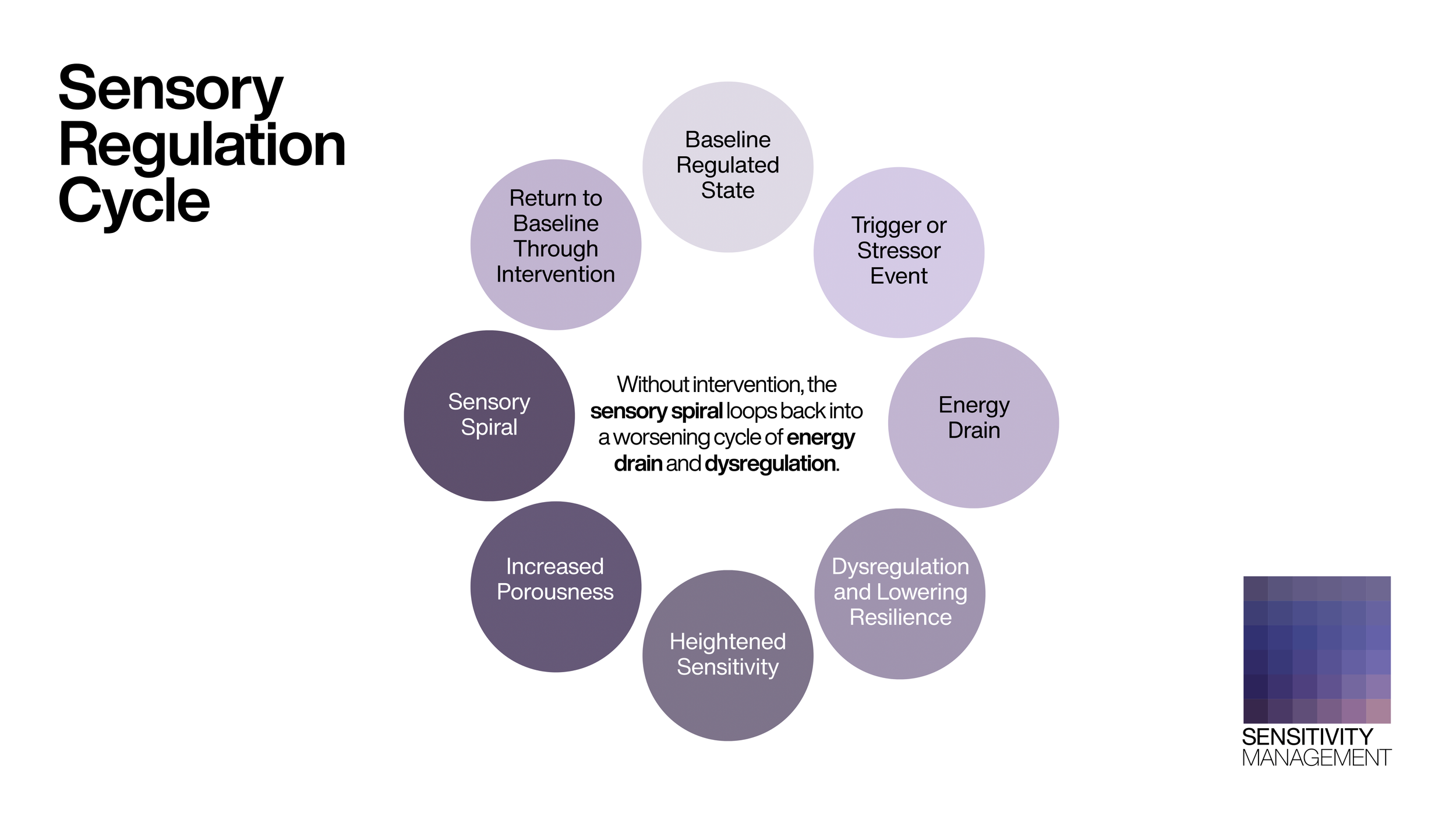
This response isn’t a flaw. It’s biology. It’s our survival mechanism.
And yet, we continue to treat sensitivity as if it’s something we need to get rid of. While sensitivity comes with certain pitfalls that we need to become more aware of and manage better, it certainly doesn’t negate its powerful skill set and attributes.
So let me ask you this: do you really want to get rid of your survival mechanism? Your empathy. Your passion. Your strategic ability. Your creativity. Your ability to feel and adapt.
Neither do I.
These are vital assets sensitivity provides, designed to help us navigate life’s challenges and connect with the world around us. Perhaps it’s time to rethink how we view this part of ourselves.
Because after all, our sensitivity matters.